Mortgage Rates
6.67%
Freddie Mac 30-year fixed benchmark for the week ending August 13, 2026. Investor financing can price differently.
Source: Freddie Mac PMMS →DealGapIQ Investor Intelligence
Real estate data is everywhere. DealGapIQ Investor Intelligence separates signal from noise and translates market trends into the numbers residential investors actually need to make acquisition decisions.
Market Pulse
Verified data points are shown with their source and reporting period. Measures still being built remain clearly labeled.
Freddie Mac 30-year fixed benchmark for the week ending August 13, 2026. Investor financing can price differently.
Source: Freddie Mac PMMS →Investor share of 2025 purchases in Realtor.com’s deed-based corporate-investor dataset. Definitions vary by provider.
Source: Realtor.com Research →National averages can hide large metro differences. DealGapIQ will publish verified price measures with source and reporting period.
Rental demand remains supported by affordability constraints, while rent growth, vacancy, and new supply vary materially by market.
Featured Intelligence
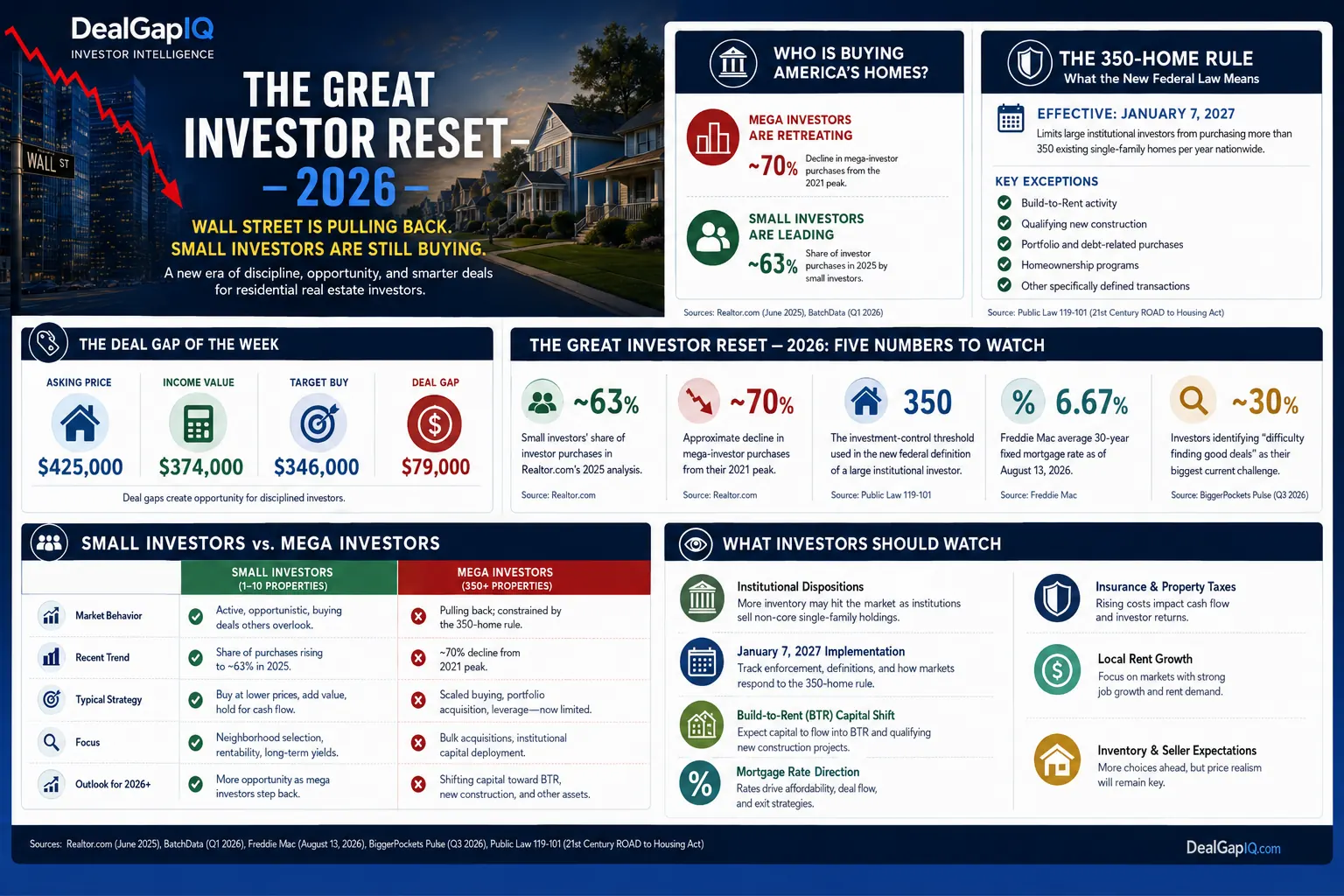
Institutional acquisition activity has retreated sharply from pandemic-era peaks while small investors account for a growing share of investor purchases. New federal restrictions are changing the rules for large buyers—but expensive financing and rising operating costs mean opportunity still has to pencil.
The market is not running out of properties. It is running out of properties that pencil.
Read the Full Analysis →Trending Now
The opening ten analyses of The Great Investor Reset — 2026. Topic #1 is live; the remaining reports will roll out through the campaign.
Institutional investors are changing strategy. Smaller investors remain active. Financing costs are higher, operating expenses are rising, and easy cash flow is harder to find. We examine what the changing residential investment landscape means for independent investors.
New federal restrictions are changing the acquisition landscape for large institutional owners of single-family homes. We will examine who is covered, which properties are affected, the major exceptions, and why build-to-rent remains part of the story.
Properties are available. But finding an acquisition where purchase price, rent, financing, expenses, and required returns all work together has become considerably more difficult.
Higher financing costs, more expensive insurance, rising taxes, and thinner margins mean investors need to rethink what they are willing to pay. The question is what price makes the property work today.
Housing headlines can appear contradictory because different indexes measure different parts of the market. We examine what investors should actually watch when determining whether property values support the asking price.
A historic development pipeline brought substantial new apartment supply into many U.S. markets. Now construction activity is slowing, setting up a different phase of the cycle.
Housing affordability, household formation, lifestyle renting, institutional capital, development economics, and changing federal policy are creating a new strategic environment for build-to-rent.
The purchase price determines how much room an investor has for renovation, financing, holding costs, commissions, unexpected repairs, market changes, and profit.
Foreign residential purchasing activity has moderated from prior levels. We examine where that activity matters most and whether the change creates meaningful openings for domestic investors.
Fast appreciation does not automatically make a market a good investment market. DealGapIQ will compare markets using price, rent, taxes, insurance, financing, vacancy, yield, and Deal Gap.
Deal Gap of the Week
Every week, DealGapIQ Investor Intelligence will analyze a real residential investment property and compare the seller's asking price with the economics supported by the property.
What the seller wants.
What the property's income supports.
The acquisition price supported by the investor's objectives.
The difference between the seller’s number and the number that makes the investment work.
We will test purchase-price negotiation, income, financing structure, equity, seller concessions, renovation, expense reduction, and alternative deal structure.
Analyze Your Own PropertyCoverage
Seven areas of residential investment coverage. Every one ends at the same question: what does this mean for the deal?
The term real estate investor can describe everyone from someone purchasing a first rental property to a corporation controlling thousands of homes. Those investors do not behave the same way.
A desirable location, strong rental demand, attractive photos, and a motivated seller do not mean the numbers work. The investment starts with price, income, expenses, financing, and required return.
Financing does more than change a monthly payment. It changes cash flow, DSCR, cash-on-cash return, required equity, purchasing power, and maximum acquisition price.
Single-family rentals remain a major component of U.S. residential investing. We track the forces influencing SFR performance and acquisition economics.
A wave of apartment construction reshaped rental conditions across many markets. Investors are now watching the supply pipeline, absorption, occupancy, rent growth, financing, and transaction activity.
Build-to-rent combines characteristics of single-family housing, multifamily operations, development, and institutional investment.
Before renovation begins, investors need enough margin to absorb construction, financing, holding costs, closing costs, commissions, surprises, and profit.
DealGapIQ Market Intelligence
The goal is to move beyond generic lists of America's “hottest” housing markets and identify something more useful: markets where price, income, operating costs, financing, and deal availability create compelling investment economics.
The future market map will compare residential markets on price, rent, taxes, insurance, vacancy, financing, yield, and deal availability.
Proprietary Intelligence
Proprietary measures will publish only with a transparent methodology and enough data to make the result robust and explainable.
A multidimensional measure of residential investment conditions.
In DevelopmentDesigned to measure how frequently listed properties approach investor-supported acquisition values.
In DevelopmentDesigned to measure the impact of prices, financing, and operating expenses on investor purchasing power.
In DevelopmentDesigned to identify markets where rental economics appear comparatively attractive.
In DevelopmentDesigned to measure the difference between asking prices and DealGapIQ-supported Target Buy values across a market.
In DevelopmentLatest Investor Intelligence
Institutional investors are changing strategy. Smaller investors remain active. Financing costs are higher, operating expenses are rising, and easy cash flow is harder to find. We examine what the changing residential investment landscape means for independent investors.
New federal restrictions are changing the acquisition landscape for large institutional owners of single-family homes. We will examine who is covered, which properties are affected, the major exceptions, and why build-to-rent remains part of the story.
Properties are available. But finding an acquisition where purchase price, rent, financing, expenses, and required returns all work together has become considerably more difficult.
Higher financing costs, more expensive insurance, rising taxes, and thinner margins mean investors need to rethink what they are willing to pay. The question is what price makes the property work today.
Housing headlines can appear contradictory because different indexes measure different parts of the market. We examine what investors should actually watch when determining whether property values support the asking price.
A historic development pipeline brought substantial new apartment supply into many U.S. markets. Now construction activity is slowing, setting up a different phase of the cycle.
Methodology
Use authoritative and transparent sources whenever possible.
Explain why different datasets can reach different conclusions.
Translate the statistic into an actual investment decision.
Test market changes against property-level economics.
Market intelligence tells you where to look. Property intelligence tells you whether to buy.
Every residential investment ultimately comes down to the numbers.
What the seller wants.
What the property's income supports.
The acquisition price supported by the investor's objectives.
The difference between the seller’s number and the number that makes the investment work.
The Gap Is the Deal.
Analyze a Property