The Great Investor Reset — 2026
Investor Trends
Wall Street Is Pulling Back. Small Investors Are Still Buying.
The investor market is being redistributed—not disappearing. Here is what the shift means for independent residential real estate investors.
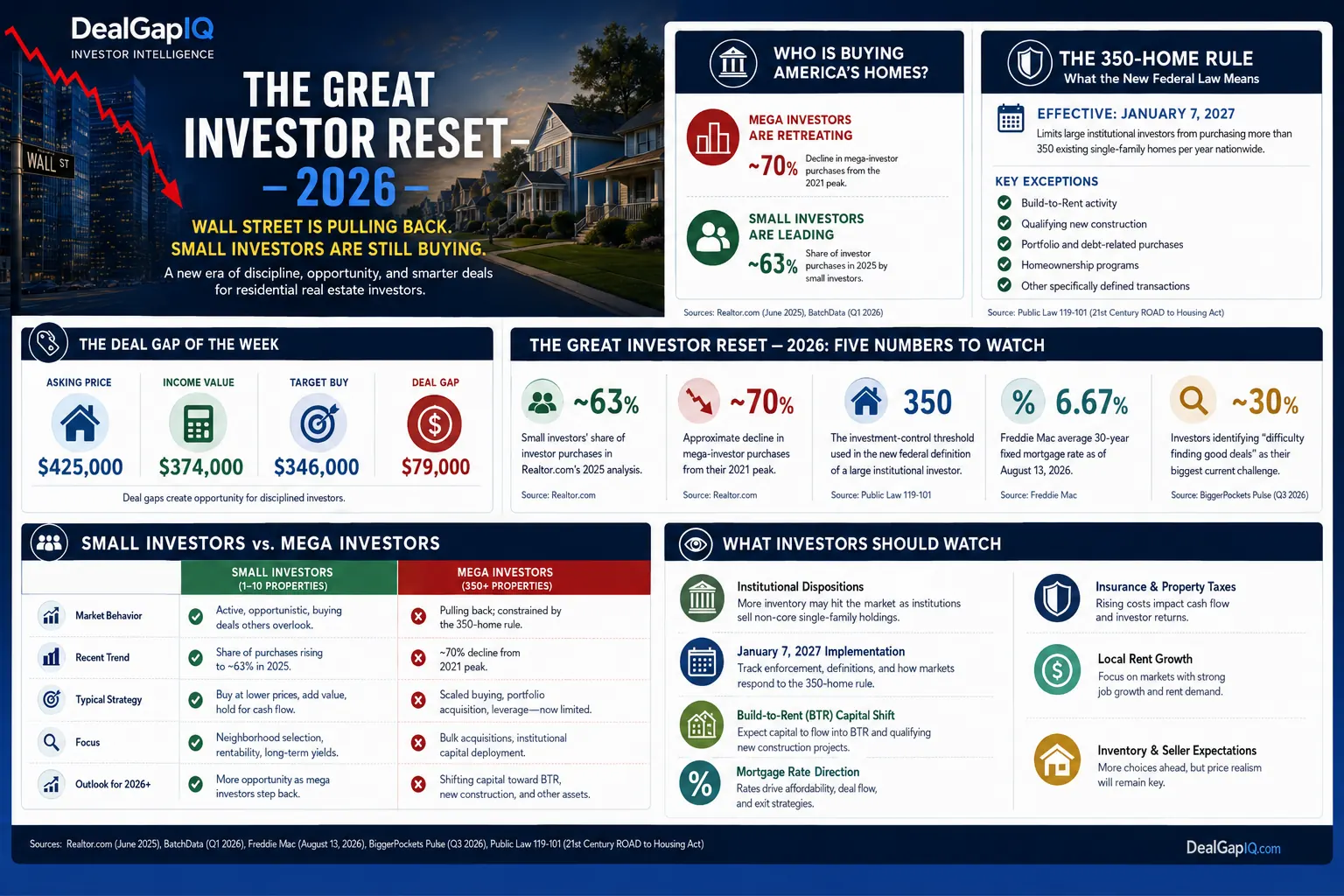
DealGapIQ Investor Intelligence · The Great Investor Reset — 2026
Something important is changing inside the U.S. residential investment market.
For years, one of the dominant narratives around housing has been simple: Wall Street is buying America's homes.
That story is becoming increasingly incomplete.
Large and mega-sized investors have sharply reduced acquisition activity from their pandemic-era highs. Smaller investors remain active and account for a growing share of investor purchases. A new federal law will soon restrict additional purchases of many existing single-family homes by covered large institutional investors.
But that does not mean residential real estate investing suddenly became easy.
Financing costs remain elevated. Insurance, property taxes, maintenance, and renovation costs continue to pressure returns. Appreciation has slowed from pandemic-era rates. Rental growth is more moderate in many markets.
And in the latest BiggerPockets Pulse survey, the most commonly cited investor challenge was not mortgage rates. It was difficulty finding good deals.
Welcome to what DealGapIQ calls The Great Investor Reset — 2026.
This is not a housing crash. It is not another 2021-style boom. And it is not the disappearance of residential investors.
It is a redistribution of opportunity—and a return to investment discipline.
The investors most likely to succeed in this environment may not be the ones who buy the most properties. They may be the ones who know exactly what they can afford to pay.
What Investors Need to Know
- Small investors now account for roughly 63% of investor purchases in Realtor.com's 2025 corporate-investor dataset.
- Mega-investor purchase volume is nearly 70% below its 2021 peak in the same dataset.
- Redfin found investor purchases fell 6% year over year in Q1 2026, even though investors still represented about 19% of purchases across the 39 major metros it tracks.
- The 21st Century ROAD to Housing Act became law on July 11, 2026 and generally uses a 350-home investment-control threshold for covered large institutional investors.
- The law's purchase restrictions take effect 180 days after enactment—January 7, 2027—and include important exceptions.
- Freddie Mac's 30-year fixed benchmark averaged 6.67% for the week ending August 13, 2026. Investor loan products can price differently.
- BiggerPockets' Q3 2026 Pulse found nearly 30% of respondents named difficulty finding good deals as their biggest current challenge.
The combined message is straightforward: investor demand has not disappeared, but easy acquisition math has.
“Investor Activity” Is Not One Number
If you follow housing headlines, you may see dramatically different statistics describing the percentage of homes being purchased by investors.
One report may say about 11%. Another may say 19%. Another may put the figure above 30%.
Those numbers can all be based on real data because providers define the market differently.
Realtor.com Research reported that investors purchased about 534,000 homes in 2025, representing 11.3% of purchases in its deed-based corporate-investor dataset.
Redfin found investors represented about 19% of purchases in Q1 2026 across 39 major U.S. metropolitan areas, even as the actual number of investor purchases fell 6% year over year.
BatchData, using a broader ownership and transaction methodology, calculated an investor purchase share of 31.85% in Q1 2026 while also reporting that investor purchase volume fell to a nine-quarter low.
The apparent contradiction contains one of the most important lessons of the current market:
A high investor share does not necessarily mean investors are buying more homes.
Sometimes investors simply represent a larger percentage of a market in which traditional buyers are transacting less.
That distinction matters. It separates share of activity from absolute activity.
The Bigger Story: Which Investors Are Buying?
“Investor” is an extraordinarily broad category.
It can describe someone buying a second rental, a local LLC with six houses, a regional operator with hundreds of properties, or a public company controlling tens of thousands of homes.
Those buyers do not behave the same way.
In Realtor.com's 2025 analysis, small investors—defined in that dataset as corporate entities with 1–10 cumulative purchases—accounted for roughly 63% of investor purchases. Their share rose from about 53% at the pandemic-era peak.
Mega investors moved in the opposite direction.
Realtor.com defines mega investors as entities with more than 350 cumulative purchases in its dataset. By 2025, they represented just 7.5% of investor purchases, their smallest share since at least 2011, and their purchase volumes were down nearly 70% from the 2021 peak.
The net-buying picture is even more revealing.
Realtor.com found small investors purchased roughly 53,000 more properties than they sold in 2025. Mega investors, by contrast, had moved from net accumulation during the pandemic surge to substantial net selling in recent years.
BatchData reaches a similar directional conclusion through a different lens: it estimates investors holding 1–10 homes account for about 96% of investor-owned single-family stock, while investors owning 1,000 or more homes represent a much smaller share.
These datasets should not be blended as though they measure the same thing. They do not. But they point toward the same broader shift:
The investor market increasingly looks less like one institutional wave and more like a fragmented market dominated by smaller operators.
Small Investors Are Active Where Price Matters Most
The shift has another important dimension: small investors tend to operate lower in the price spectrum.
Realtor.com reported a $330,000 median purchase price for small investors in 2025, compared with an overall market median of about $440,000 in its analysis.
That puts smaller investors in the same broad segment that attracts:
- first-time homebuyers,
- rental investors,
- value investors,
- flippers,
- BRRRR operators,
- and local landlords.
Kansas City illustrates the point. Realtor.com found investors purchased 21.2% of homes sold there in 2025. Small investors represented 9.5% of all purchases and bought at a median price of about $240,000, compared with an overall market median of roughly $347,000.
So a pullback by the largest institutional buyers does not necessarily eliminate competition in the lower-priced housing segment.
In many markets, that competition may simply become more local and more fragmented.
Washington Has Changed the Rules
The institutional pullback was already underway before the latest federal policy change.
Now the rules themselves are changing.
The 21st Century ROAD to Housing Act became Public Law 119-101 on July 11, 2026.
Under the new law, a covered “large institutional investor” generally includes a qualifying for-profit entity that is engaged in investing in, owning, renting, managing, or holding single-family homes and that, alone or in concert with related entities, has investment control of at least 350 single-family homes, subject to the law's detailed definitions and exclusions.
The requirements and prohibitions affecting additional purchases take effect 180 days after July 11, 2026, which is January 7, 2027.
The policy is significant—but the headline version can easily become misleading.
What the law does not do
It does not simply require every large institutional owner to immediately liquidate its existing portfolio.
What the law does do
It generally restricts covered large institutional investors from making additional purchases of covered existing single-family homes, subject to a series of exceptions and transition provisions.
Those exceptions include categories involving newly constructed housing, qualifying renovation or rental-conversion activity, certain foreclosure and debt-satisfaction transactions, qualifying senior housing, transfers between covered investors, and other defined transactions.
That means the practical story is more nuanced than “Wall Street banned from housing.”
The more accurate interpretation is:
Federal policy is making conventional accumulation of existing scattered-site single-family homes more difficult for very large investors, while preserving defined paths for new supply, renovation, and other qualifying transactions.
That could influence where institutional capital goes next—and it is one reason build-to-rent deserves separate attention.
Less Institutional Competition Does Not Mean Easy Deals
This is where the Great Investor Reset becomes especially important for independent investors.
Suppose institutional acquisition activity falls.
Does that automatically create great deals for smaller investors?
No.
Institutional competition is only one component of investment economics.
A property still has to overcome:
- purchase price,
- interest rate,
- property taxes,
- insurance,
- repairs,
- maintenance,
- vacancy,
- management,
- HOA costs,
- renovation,
- closing costs,
- and the investor's required return.
Those numbers remain challenging.
Freddie Mac's Primary Mortgage Market Survey showed the benchmark 30-year fixed mortgage averaging 6.67% for the week ending August 13, 2026. That benchmark reflects conventional conforming mortgage applications; investment-property, DSCR, private-money, and other investor products can price differently.
The point is not that every investor is borrowing at 6.67%.
The point is that the broader cost-of-capital environment remains radically different from the sub-3% mortgage era.
When financing is expensive while property prices and operating costs remain elevated, something has to adjust.
Either:
- income rises,
- expenses fall,
- the investor accepts a lower return,
- the investor contributes more equity,
- the financing structure improves,
- or the purchase price changes.
Investors Are No Longer Waiting for Rates to Save Them
The Q3 2026 BiggerPockets Pulse offers a revealing look at retail-investor psychology.
Nearly 30% of respondents identified difficulty finding good deals as their biggest current challenge.
Rising expenses such as insurance and taxes and a lack of capital for new deals followed closely, each around 25%.
High mortgage rates—the complaint that dominated investor conversations for years—were selected by only about 13% as the biggest current challenge.
The opportunity side of the survey is equally interesting.
The most commonly cited opportunity was greater ability to negotiate, selected by 27.5% of respondents. Falling prices followed at 24%, while increasing inventory and better deal flow came in at 21.5%.
That describes a very different market than 2021.
Back then, speed often mattered more than precision.
Today, precision matters more than speed.
2021 Could Forgive Weak Underwriting
There was a period when an investor could make a mediocre acquisition and still look smart twelve months later.
Rapid appreciation could cover mistakes.
Cheap financing could support thin yields.
Fast rent growth could improve weak initial cash flow.
Easy refinancing could create another exit.
That environment encouraged a mindset of:
“Get the property first. We'll figure it out later.”
The 2026 market is less forgiving.
If appreciation is modest, debt is expensive, insurance rises after closing, taxes reset, and rent growth does not outperform projections, there may be nothing available to rescue a bad acquisition.
That changes the fundamental question.
Instead of asking:
“Do I like this property?”
A disciplined investor asks:
“At what price do I like this property?”
Those are not the same question.
Illustrative DealGapIQ Example: A Property Is Not the Deal
Consider a rental property listed at $425,000.
After analyzing realistic rental income, vacancy, taxes, insurance, maintenance, financing, and required return, assume the investor concludes the property's income supports an Income Value of $374,000.
After applying the investor's financing and return requirements, the Target Buy is $346,000.
| Metric | Amount |
|---|---|
| Asking Price | $425,000 |
| Income Value | $374,000 |
| Target Buy | $346,000 |
| Deal Gap | $79,000 |
The seller wants $425,000.
The investor's number is $346,000.
The difference is $79,000.
That is the Deal Gap.
The existence of a gap does not automatically mean the investor should walk away. It identifies the problem that must be solved.
Can the purchase price move? Can income improve? Can the financing structure change? Can seller concessions close part of the difference? Is renovation capable of creating enough incremental value? Are expenses genuinely reducible?
Or is the gap telling you something equally valuable:
This is not your deal.
That is intelligence too.
The figures above are illustrative only and are not an analysis of a currently listed property.
The Opportunity May Be Shifting Toward Better Operators
The Great Investor Reset is not simply transferring properties from institutions to mom-and-pop buyers.
It is shifting the advantage toward investors who can:
- underwrite accurately,
- understand local rents,
- model realistic expenses,
- negotiate intelligently,
- evaluate financing alternatives,
- avoid emotional acquisitions,
- recognize when assumptions are doing too much work,
- and walk away from bad numbers.
The opportunity is not:
“Wall Street is gone. Buy everything.”
It is:
“Competition is changing. Make better decisions.”
The Great Investor Reset in Five Numbers
63%
Small investors' approximate share of investor purchases in Realtor.com's 2025 corporate-investor analysis.
Nearly 70%
Approximate decline in mega-investor purchase volume from the 2021 peak in the same dataset.
19%
Investor share of Q1 2026 purchases across the 39 major metros in Redfin's analysis—even as investor purchase count fell 6% year over year.
350 Homes
The investment-control threshold used in the new federal definition of a covered large institutional investor, subject to the statute's full definitions, aggregation rules, and exceptions.
Nearly 30%
BiggerPockets Pulse respondents identifying difficulty finding good deals as their largest current challenge in Q3 2026.
Put together, the numbers describe a market with persistent investor participation, less aggressive mega-investor accumulation, higher costs, and much greater pressure on acquisition discipline.
What Investors Should Watch Next
Institutional dispositions
Do the largest owners continue selling more existing homes than they acquire, or does the pace of dispositions stabilize?
January 7, 2027
How does acquisition behavior change as the ROAD to Housing Act's institutional purchase restrictions take effect?
Build-to-rent
Does more institutional capital shift toward creating new rental supply and other strategies that fit within the new policy framework?
Mortgage and investor loan rates
Not because investors should wait for a magical rate, but because changes in debt cost change the maximum supportable acquisition price.
Insurance and property taxes
These expenses can destroy a deal that appears attractive when viewed only through price and rent.
Rent growth and vacancy
Can income keep pace with operating expenses in the specific market being analyzed?
Seller expectations
More listings do not automatically mean more deals. A transaction becomes viable when the seller's expectations and the investor's economics become close enough to transact.
The DealGapIQ Perspective
Every market transition produces a search for a simple answer.
Is this a buyer's market?
Is it a seller's market?
Are investors buying?
Are they selling?
Are prices going up or down?
Those questions are useful—but incomplete for an investor.
Because you do not buy “the U.S. housing market.”
You buy one property, at one price, with one income stream, under one financing structure, with one set of expenses.
The national market can tell you where conditions are moving.
It cannot tell you whether a particular property is worth the asking price to you.
That is the final step.
And in the Great Investor Reset of 2026, it may be the step that matters most.
The market is not running out of properties. It is running out of properties that pencil.
The opportunity is still there.
But increasingly, you have to find the gap.
What's Next: The 350-Home Rule
Next in The Great Investor Reset series, DealGapIQ Investor Intelligence will break down the new federal institutional-investor restrictions in detail: the 350-home threshold, covered properties, effective date, important exceptions, build-to-rent implications, and what the policy could mean for independent investors.
Coming next: The 350-Home Rule: What the New Institutional Investor Law Actually Means.
Sources & Methodology
This analysis uses multiple datasets because “investor” is not defined consistently across the industry. Figures should not be treated as interchangeable when the provider, property universe, geography, ownership definition, or investor-size methodology differs.
- Realtor.com Research — Investor Report, June 23, 2026
- Redfin — Investor Home Purchases Fall to Lowest Level Since 2020, May 28, 2026
- BatchData — Investor Pulse Q1 2026
- U.S. Government Publishing Office — Public Law 119-101, approved July 11, 2026
- U.S. Code — Large Institutional Investor provisions
- Freddie Mac — Primary Mortgage Market Survey
- BiggerPockets — Q3 2026 Pulse
DealGapIQ Investor Intelligence is provided for informational and educational purposes only and is not investment, financial, tax, or legal advice. Verify source data and property-level assumptions independently before making an investment decision.
DealGapIQ
Understand the market. Then analyze the property.
Market intelligence shows where conditions are moving. DealGapIQ helps you test whether the individual property works at the price, income, financing, and return assumptions that matter to you.
Analyze a Property →